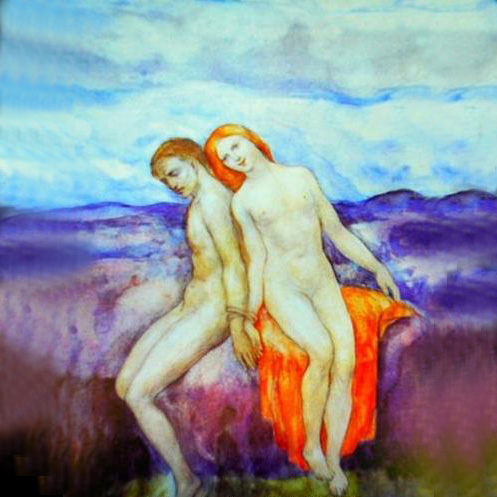
Showing posts with label Kahlil Gibran. Show all posts

Saturday, May 13, 2023

Your Children Are Not Your Children


"Your children are not your children.

They are the sons and daughters of life's longing for itself."

- Kahlil Gibran


A reflection

It is only human to be devoted and attached to one's family. To desire a good relationship with one's own children is probably the most genuine desire of any parent. To lose the connection, whether by death or by life, causes suffering. 

To come to peace with this loss is possible..; to lay the suffering to rest is also possible. But it is only possible when to the profoundest depths is understood that love is not an exclusive blessing for one's own loved ones, but that love abounds and permeates everything. Then the heart calms down and the surrender to what is simply follows.


⚜️⚜️⚜️


Art: Les enfants de Bretagne by Emil Vernon


Tuesday, June 14, 2022

Between Christ and Ishtar


In the midst of the gardens and hills which connect the city of Beirut with Lebanon there is a small temple, very ancient, dug out of white rock, surrounded by olive, almond, and willow trees. Although this temple is a half mile from the main highway, at the time of my story very few people interested in relics and ancient ruins had visited it. It was one of many interesting places hidden and forgotten in Lebanon. Due to its seclusion, it had become a haven for worshippers and a shrine for lonely lovers.

As one enters this temple he sees on the wall at the east side an old Phoenician picture, carved in the rock depicting Ishtar, goddess of love and beauty, sitting on her throne, surrounded by seven nude virgins standing in different posses. The first one carries a torch; the second, a guitar; the third, a censer; the fourth a jug of wine; the fifth, a branch of roses; the sixth, a wreath of laurel; the seventh, a bow and arrow; and all of them look at Ishtar reverently.

On the second wall there is another picture, more modern than the first one, symbolizing Christ nailed to the cross, and at His side stand His sorrowful mother and Mary Magdalene and two other women weeping. This Byzantine picture shows that it was carved in the fifteenth or sixteenth century.

On the west side wall there are two round transits through which the sun's rays enter the temple and strike the pictures and make them look as if they were painted with gold water color. In the middle of the temple there is a square marble with old paintings on its sides, some of which can hardly be seen under the petrified lumps of blood which show that the ancient people offered sacrifices on this rock and poured perfume, wine, and oil upon it.

There is nothing else in that little temple except deep silence, revealing to the living the secrets of the goddess and speaking worldlessly of past generations and the evolution of religions. Such a sight carries the poet to a world far away from the one in which he dwells and convinces the philosopher that men were born religious; they felt a need for that which they could not see and drew symbols, the meaning of which divulged their hidden secrets and their desires in life and death.

In that unknown temple, I met Selma once every month and spent the hours with her, looking at those strange pictures, thinking of the crucified Christ and pondering upon the young Phoenician men and women who lived, loved and worshipped beauty in the person of Ishtar by burning incense before her statue and pouring perfume on her shrine, people for whom nothing is left to speak except the name, repeated by the march of time before the face of Eternity.

It is hard to write down in words the memories of those hours when I met Selma - those heavenly hours, filled with pain, happiness, sorrow, hope, and misery.

We met secretly in the old temple, remembering the old days, discussing our present, fearing our future, and gradually bringing out the hidden secrets in the depths of our hearts and complaining to each other of our misery and suffering, trying to console ourselves with imaginary hopes and sorrowful dreams. Every now and then we would become calm and wipe our tears and start smiling, forgetting everything except Love; we embraced each other until our hearts melted; then Selma would print a pure kiss on my forehead and fill my heart with ecstasy; I would return the kiss as she bent her ivory neck while her cheeks became gently red like the first ray of dawn on the forehead of hills. We silently looked at the distant horizon where the clouds were colored with the orange ray of sunset.

Our conversation was not limited to love; every now and then we drifted on to current topics and exchanged ideas. During the course of conversation Selma spoke of woman's place in society, the imprint that the past generation had left on her character, the relationship between husband and wife, and the spiritual diseases and corruption which threatened married life. I remember her saying: "The poets and writers are trying to understand the reality of woman, but up to this day they have not understood the hidden secrets of her heart, because they look upon her from behind the sexual veil and see nothing but externals; they look upon her through the magnifying glass of hatefulness and find nothing except weakness and submission."

On another occasion she said, pointing to the carved pictures on the walls of the temple, "In the heart of this rock there are two symbols depicting the essence of a woman's desires and revealing the hidden secrets of her soul, moving between love and sorrow—between affection and sacrifice, between Ishtar sitting on the throne and Mary standing by the cross. The man buys glory and reputation, but the woman pays the price."

No one knew about our secret meetings except God and the flock of birds which flew over the temple. Selma used to come in her carriage to a place named Pasha park and from there she walked to the temple, where she found me anxiously waiting for her.

We feared not the observer's eyes, neither did our consciences bother us; the spirit which is purified by fire and washed by tears is higher than what the people call shame and disgrace; it is free from the laws of slavery and old customs against the affections of the human heart. That spirit can proudly stand unashamed before the throne of God.

Human society has yielded for seventy centuries to corrupted laws until it cannot understand the meaning of the superior and eternal laws. A man's eyes have become accustomed to the dim light of candles and cannot see the sunlight. Spiritual disease is inherited from one generation to another until it has become a part of people, who look upon it, not as a disease, but as a natural gift, showered by God upon Adam. If those people found someone free from the germs of this disease, they would think of him with shame and disgrace.

Those who think evil of Selma Karamy because she left her husband's home and met me in the temple are the diseased and weak-minded kind who look upon the healthy and sound as rebels. They are like insects crawling in the dark for fear of being stepped upon by the passer-by.

The oppressed prisoner, who can break away from his jail and does not do so, is a coward. Selma, an innocent and oppressed prisoner, was unable to free herself from slavery. Was she to blame because she looked through the jail window upon the green fields and spacious sky? Will the people count her as being untruthful to her husband because she came from his home to sit by me between Christ and Ishtar? Let the people say what they please; Selma had passed the marshes which submerge other spirits and had landed in a world that could not be reached by the howling of wolves and rattling of snakes. People may say what they want about me, for the spirit who has seen the specter of death cannot be scared by the faces of thieves; the soldier who has seen the swords glittering over his head and streams of blood under his feet does not care about rocks thrown at him by the children on the streets.


Kahlil Gibran - from The Broken Wings


Sunday, October 27, 2019

The Essence of Desire


I did not
have to ask my heart what it wanted,
because of all desires I have ever known
just one did I cling to
for it was the essence of
all desire:
To hold beauty
in my soul's
arms.

*

John of the Cross


Painting by Kahlil Gibran

Tuesday, May 21, 2019

A Wordless Song


In the depth of my soul there is a wordless song 
A song that lives in the seed of my heart. 
It refuses to melt with ink on parchment; 
It engulfs my affection 
In a transparent cloak and flows, 
But not upon my lips. 
How can I sigh it? 
I fear it may mingle with earthly ether; 
To whom shall I sing it? 
It dwells in the house of my soul, 
In fear of harsh ears. 
When I look into my inner eyes 
I see the shadow of its shadow; 
When I touch my fingertips 
I feel its vibrations. 
The deeds of my hands heed its presence 
As a lake must reflect the glittering stars; 
My tears reveal it, as bright drops of dew 
Reveal the secret of a withering rose. 
It is a song composed by contemplation, 
And published by silence, 
And shunned by clamor, 
And folded by truth, 
And repeated by dreams, 
And understood by love, 
And hidden by awakening, 
And sung by the soul. 
It is the song of love; 
What Cain or Esau could sing it? 
It is more fragrant than jasmine; 
What voice could enslave it? 
It is heart bound, as a virgin's secret; 
What string could quiver it? 
Who dares unite the roar of the sea 
And the singing of the nightingale? 
Who dares compare the shrieking tempest 
To the sigh of an infant? 
Who dares speak aloud the words 
Intended for the heart to speak? 
What human dares sing in voice 
The Song of God? 

*
Poem and Painting
by
Khalil Gibran


Wednesday, November 7, 2018

And When My Joy Was Born


And when my Joy was born I held it in my arms and stood on the house-top shouting: "Come ye, my neighbors, come and see, for Joy this day is born unto me. Come and behold the gladsome thing that laugheth on the sun."
But none of my neighbors came to look upon my Joy, and great was my astonishment.

And every day for seven moons I proclaimed my Joy from the house-top - and yet no one heeded me. And my Joy and I were alone, unsought and unvisited.

Then my Joy grew pale and weary because no other heart but mine held its loveliness and no other lips kissed its lips.
Then my Joy died of isolation.

And now I only remember my dead Joy and remembering my dead Sorrow.

But memory is an Autumn leaf that murmurs a while in the wind and then is heard no more.


*


Kahlil Gibran

From: His Parables and Poems, 1918


Painting by Odilon Redon

Sunday, July 24, 2016

A Lover's Call


Where are you, my beloved? Are you in that little 
Paradise, watering the flowers who look upon you 
As infants look upon the breast of their mothers? 

Or are you in your chamber where the shrine of 
Virtue has been placed in your honor, and upon 
Which you offer my heart and soul as sacrifice? 

Or amongst the books, seeking human knowledge, 
While you are replete with heavenly wisdom? 

Oh companion of my soul, where are you? Are you 
Praying in the temple? Or calling Nature in the 
Field, haven of your dreams? 

Are you in the huts of the poor, consoling the 
Broken-hearted with the sweetness of your soul, and 
Filling their hands with your bounty? 

You are God's spirit everywhere; 
You are stronger than the ages. 

Do you have memory of the day we met, when the halo of 
Your spirit surrounded us, and the Angels of Love 
Floated about, singing the praise of the soul's deed? 

Do you recollect our sitting in the shade of the 
Branches, sheltering ourselves from Humanity, as the ribs 
Protect the divine secret of the heart from injury? 

Remember you the trails and forest we walked, with hands 
Joined, and our heads leaning against each other, as if 
We were hiding ourselves within ourselves? 

Recall you the hour I bade you farewell, 
And the Maritime kiss you placed on my lips? 
That kiss taught me that joining of lips in Love 
Reveals heavenly secrets which the tongue cannot utter! 

That kiss was introduction to a great sigh, 
Like the Almighty's breath that turned earth into man. 

That sigh led my way into the spiritual world, 
Announcing the glory of my soul; and there 
It shall perpetuate until again we meet. 

I remember when you kissed me and kissed me, 
With tears coursing your cheeks, and you said, 
"Earthly bodies must often separate for earthly purpose, 
And must live apart impelled by worldly intent. 

"But the spirit remains joined safely in the hands of 
Love, until death arrives and takes joined souls to God. 

"Go, my beloved; Love has chosen you her delegate; 
Over her, for she is Beauty who offers to her follower 
The cup of the sweetness of life. 
As for my own empty arms, your love shall remain my 
Comforting groom; your memory, my Eternal wedding." 

Where are you now, my other self? Are you awake in 
The silence of the night? Let the clean breeze convey 
To you my heart's every beat and affection. 

Are you fondling my face in your memory? That image 
Is no longer my own, for Sorrow has dropped his 
Shadow on my happy countenance of the past. 

Sobs have withered my eyes which reflected your beauty 
And dried my lips which you sweetened with kisses. 

Where are you, my beloved? Do you hear my weeping 
From beyond the ocean? Do you understand my need? 
Do you know the greatness of my patience? 

Is there any spirit in the air capable of conveying 
To you the breath of this dying youth? Is there any 
Secret communication between angels that will carry to 
You my complaint? 

Where are you, my beautiful star? The obscurity of life 
Has cast me upon its bosom; sorrow has conquered me. 

Sail your smile into the air; it will reach and enliven me! 
Breathe your fragrance into the air; it will sustain me! 

Where are you, my beloved? 
Oh, how great is Love! 
And how little am I! 

*

Text and Artwork
by
Kahlil Gibran


Saturday, April 11, 2015

The Mystic Heart


Many of the posts which you may read here are about mystics. We tend for convenience to label these mystics according to when they lived. There are the mystics of the Ancient World, such as Pythagoras, and Pythia, the Delphic oracle, who was believed to be possessed by the god Apollo when she uttered her mysterious pronouncements. There are the mystics of the Middle Ages and the Renaissance. Hildegard von Bingen, Hadewijch of Brabant, Teresa of Avila and Julian of Norwich are four such mystics whose remarkable visions and insights seem at times to penetrate to the very heart of greater mysteries. And there are the contemporary mystics of our own times, such as Kahlil Gibran, Etty Hillesum and Rabindranath Tagore, whose writings offer profound insights into the human condition, and so touch us all.

We can name all these names, and we collectively call them mystics, but is it possible to find some defining thread of meaning and experience that would allow us actually to say what a mystic is? Perhaps if this were possible, it might bring us a step closer , not just to understanding them, but to experience in some way the things which they experienced, to share with them these remarkable insights which go deeper than our own everyday experiences.

One thing is very clear, even from this brief list of names: mysticism is gender-blind. Both men and women were and are regarded as mystics of equal stature. Even in a church whose hierarchy was and is essentially male-dominated, the mystics of the Middle Ages often were women who moved in a man’s world, and still made their mark on history. I think of Hildegard, who in contemporary accounts was described as being small and slight of stature, but who nevertheless negotiated her way through a world dominated by the bishops who were her superiors to gain respect and recognition for her visions and insights.

But if gender is irrelevant to mystic experience, what qualities tie such mystics together? What line binds Pythia to Hildegard, so remote in time from each other? What links the Lebanese Gibran to the Bengali Tagore, who might have been separated by their different cultures, but who nevertheless were each other’s contemporaries? We might say the obvious, and name their devotion to their beliefs. All mystics were on a quest, and this quest took the form of a need, even a passionate desire, to have a contact in some form with a deeper aspect of their faith. For a mystic, doctrine was not enough. A mystic desired something more, something beyond the borders that others had erected around their particular faith. A mystic was – and is – seeking a direct experience of the Divine.

Such a path cannot be trodden by careful route planning, by wondering what we are going to do next, by thinking carefully about the thoughts that might or might not guide us. Such thoughts are only distractions. A mystic does not walk a path. A mystic is the path, and total trust and surrender are the companions along the way. Every movement is a movement made in love, and every gesture is a gesture of love, of love for the inexpressible Divine. 

When Julian of Norwich said that ‘all shall be well’, I do not believe that it was an expression of hope. I feel that she made the statement out of total certainty. She knew with every fibre of her being that it would be so, even though the end of her journey was not yet in sight. 


Photo: sculpture Teresa of Avila by Fr. Lawrence Lew

Friday, January 24, 2014

Song of the Soul

Song of the Soul 
by Kahlil Gibran

In the depth of my soul there is 
A wordless song - a song that lives 
In the seed of my heart. 
It refuses to melt with ink on 
Parchment; it engulfs my affection 
In a transparent cloak and flows, 
But not upon my lips. 

How can I sigh it? I fear it may 
Mingle with earthly ether; 
To whom shall I sing it? It dwells 
In the house of my soul, in fear of 
Harsh ears. 

When I look into my inner eyes 
I see the shadow of its shadow; 
When I touch my fingertips 
I feel its vibrations. 

The deeds of my hands heed its 
Presence as a lake must reflect 
The glittering stars; my tears 
Reveal it, as bright drops of dew 
Reveal the secret of a withering rose. 

It is a song composed by contemplation, 
And published by silence, 
And shunned by clamor, 
And folded by truth, 
And repeated by dreams, 
And understood by love, 
And hidden by awakening, 
And sung by the soul. 

It is the song of love; 
What Cain or Esau could sing it? 

It is more fragrant than jasmine; 
What voice could enslave it? 

It is heartbound, as a virgin's secret; 
What string could quiver it? 

Who dares unite the roar of the sea 
And the singing of the nightingale? 
Who dares compare the shrieking tempest 
To the sigh of an infant? 
Who dares speak aloud the words 
Intended for the heart to speak? 
What human dares sing in voice 
The song of God?  


A veiled beauty by Frederick Arthur Bridgman


Thursday, November 14, 2013

Birds of Passage


A wise rabbi once said: “It is a great challenge always to be in joy, to make yourself strong, and with all your force, to banish sadness and bitterness out of you. All sickness that comes over human beings, come forth out of the descent of joy. The descent of joy comes from the deformation of the ‘deep song’, of the vital rhythms. When joy and this deep song are affected, sickness can overcome us. Joy is a great remedy. It is important to find one place in us which gives us joy, and attach ourselves to it."

Another wise voice – that of Khalil Gibran’s – said of joy and sorrow: "Your joy is your sorrow unmasked, and the deeper that sorrow carves into your being, the more joy you can contain." 

Joy works in us. To enjoy – to ‘en-joy’ – is a way of living which gives spirit and flow. Joy seems to embrace a whole spectrum of verbs: to trust, to heal, to give, to receive, to dance, to sing, to share, to make love: all ways of living from the heart.

And we wish this joy for everyone, which is what can keep us going. But we also will encounter the pain of joy – the joy which has its borders:  borders which always will be there in some form. And when we experience injustice, it is this sense of injustice which can harden these borders. Still we know: I am on my life's journey. Like the migrating birds of passage, after their African sojourn, journey north  to breed and face storm and rain on their journey, in the same way the soul, full of joyful anticipation, hurries straight through the opposing forces towards her destination, which is complete joy.

The way of joy is a way to self-knowledge. For along this road of joy, just as the birds meet their headwinds and storms, we will meet our inner obstructions. We will be given a panoramic view of our fears and flaws, our weaknesses and pains, and we learn that we carry traumas within which cannot be healed. It is understandable that many of us will lose heart altogether, falling into grief and depression, or even face illness which no doctor can heal.

And still we make the attempt to keep enjoying, even though the social pressures to remain positive, to ‘look on the bright side’, can at times appear clichéd and hollow to the point of seeming cynical. For sometimes the pain is too deep, too fierce, for us to be able to discover the tiniest bud of joy in ourselves. But…

No night so dark that it will become morning again, is a line in a song by a Dutch troubadour.

We have to break in order for the light to come in, a dear friend once said to me. How right he was. For in the crack of breaking one will see, however small or faint, this spark. It is the spark of creation! However softly-glowing, it will find its way to our wounded heart, and begin to shine from within. The more we hold on to it, nurture it, the more this creative joy comes to light, and back into our life again.

When that wise rabbi asks of us to be strong, and with all our force to banish sadness and bitterness from us, and Khalil Gibran tells us that joy and sorrow are inseparable, I like to believe that they both contain their own truth. We all have experiences of joy and sorrow to know that we need to be strong like the birds of passage, facing storms and losses, but also experiencing those moments of pure joy, of effortless soaring over the moonlit oceans.


Painting Joy and Sorrow by Kahlil Gibran

Tuesday, March 19, 2013

Rachel, a Woman Disciple


Rachel, a Woman Disciple
on Jesus, the Vision and the Man

I often wonder whether Jesus was a man of flesh and blood like ourselves, or a thought without a body, in the mind, or an idea that visits the vision of man.
Often it seems to me that he was but a dream dreamed by countless men and women at the same time in a sleep deeper than sleep and a dawn more serene than all dawns.

And it seems that in relating the dream, the one to the other, we began to deem it a reality that had indeed come to pass; and in giving it body of our fancy and a voice of our longing we made it a substance of our own substance.

But in truth he was not a dream. We knew him for three years and beheld him with open eyes in the high tide of noon. We touched his hands, and followed him from one place to another. We heard his discourses and witnessed his deeds. Think you that we were a thought seeking after more thought, or a dream in the region of dreams?

Great events always seem alien to our daily lives, though their nature may be rooted in our nature. But though they appear sudden in their coming and sudden in their passing, their true span is for years and for generations.

Jesus of Nazareth was himself the Great Event. That man whose father and mother and brothers we know, was himself a miracle wrought in Judea. Yea, all his own miracles, if placed at his feet, would not rise to the height of his ankles. And all the rivers of all the years shall not carry away our remembrance of him.

He was a mountain burning in the night, yet he was a soft glow beyond the hills. He was a tempest in the sky, yet he was a murmur in the mist of daybreak. He was a torrent pouring from the heights to the plains to destroy all things in his path. And he was like the laughter of children.

Every year I had waited for spring to visit this valley. I had waited for the lilies and the cyclamen, and then every year my soul had been saddened within me; for ever I longed to rejoice with the spring, yet I could not.

But when Jesus came to my seasons he was indeed a spring, and in him was the promise of all the years to come. He filled my heart with joy; and like the violets I grew, a shy thing, in the light of his coming. And now the changing seasons of worlds not yet ours shall not erase his loveliness from this, our world.

Nay, Jesus was not a phantom, nor a conception of the poets. He was man like yourself and myself. But only to sight and touch and hearing; in all other ways he was unlike us.

He was a man of joy; and it was upon the path of joy that he met the sorrows of all men. And it was from the high roofs of his sorrows that he beheld the joy of all men.

He saw visions that we did not see, and heard voices that we did not hear; and he spoke as if to invisible multitudes, and ofttimes he spoke through us to races yet unborn.

And Jesus was often alone. He was among us yet not one with us. He was upon earth, yet he was of the sky. And only in our aloneness may we visit the land of his aloneness.

He loved us with tender love. His heart was a winepress. You and I could approach with a cup and drink therefrom.

One thing I used to understand in Jesus: he would make merry with his listeners; he would tell jests and use plays upon words, and laugh with all the fullness of his heart, even when there were distances in his eyes and sadness in his voice. But I understand now.

I often think of the earth as a woman heavy with her first child. When Jesus was born, he was the first child. And when he died, he was the first man to die.

For did it not appear to you that the earth was stilled on that dark Friday, and the heavens were at war with the heavens? And felt you not when his face disappeared from our sight as if we were naught but memories in the mist?

Kahlil Gibran - from Jesus, the Son of Man, 1928

Drawing by Leonardo da Vinci


Wednesday, December 5, 2012

A Tear and a Smile


I would not exchange the sorrows of my heart for the jubilees of the masses, nor would I grant that the tears that flow from my parts, engulfed in gloom, be turned into burgeoning laughter. I would but for my life to remain a tear and a smile: a tear that would purify my heart and make me to understand life's hidden meanings and ambiguities, and a smile that brings me nearer to my kin and becomes my symbol for the worship of the gods; a tear with which to join the crushed of heart in solidarity, and a smile that becomes a visible token of my joy in existence.

Sooner would I perish of longing than live in dullness! Would that the depths of my soul be consumed by an eternal, unappeasable appetite for love and beauty. For I have looked all around and seen that those who are satisfied are the most wretched of all people, and are enslaved by their own earthiness. I have heard the burning sighs of unrequited love and I have found them sweeter than love satisfied.

As evening approaches, the rose folds its petals and sleeps in the embrace of her yearnings. But with the approach of the morn, she parts her lips to receive the kiss of the sun. For the life of a flower is a longing and a fulfillment, a tear and a smile.

The sea's waters become vapor and rise, gathering into a cloud. The cloud floats above the hills and the valleys until it meets a gentle breeze and then it falls, weeping towards the fields. Only then does it join the running streams and return to the sea, its home and origin. The life of a cloud is a separation and a union, a tear and a smile.

And so is it for the spirit. The individual spirit becomes separated from the greater spirit and sojourns in the world of matter, a wandering cloud over the mountains of sorrow and the plains of joy, until it meets the subtle breeze of death. The spirit thus sojourns until it returns to its origin; to the Greater Sea of Love and Beauty; to God!

~ Kahlil Gibran; from A Tear and a Smile, 1914.

Photograph: Denis Roussel

Tuesday, September 18, 2012

Song of the Wave


Song of the Wave

The strong shore is my beloved
and I am his sweetheart.
We are at last united by love, 
and then the moon draws me from him.

I go to him in haste and depart
reluctantly, with many
little farewells.

I steal swiftly from behind the
blue horizon to cast the silver of
my foam upon the gold of his sand, 
and we blend in melted brilliance.

I quench his thirst and submerge his heart; 
he softens my voice and subdues my temper.
At dawn I whisper the rules of love to him,
and he embraces me longingly.

At eventide I sing to him the song of hope, 
and then print smooth kisses upon his face;
I am swift and fearful, but he
is quiet, patient, and thoughtful. 
His broad bosom soothes my restlessness.

As the tide comes we caress each other,
and when it withdraws, 
I drop to his feet in prayer.

Many times have I danced around mermaids
as they rose from the depths and rested
upon my crest to watch the stars.

Many times have I heard lovers lost
in the vastness, and I echoed their sighs.

Many times have I teased the great rocks
and fondled them with a smile, but never
have I received laughter from them.

Many times have I lifted drowning souls
And carried them tenderly to my beloved shore.
He gives them strength as in turn he takes mine.

Many times have I stolen gems from the
depths and presented them to my beloved shore.
He takes them in silence, but still I give,
for he welcomes me ever again.

In the heaviness of night, when all
creatures seek the ghost of slumber, 
I sit up, singing at one time
and sighing at another. 
I am awake always.

Alas! Sleeplessness has weakened me!
But I am a lover, and the truth of love is strong.
I may be weary, but I shall never die.

Khalil Gibran


Wednesday, August 22, 2012

Kahlil Gibran on Talking

Kahlil Gibran ~ Self-portret
You talk when you cease to be at peace with your thoughts;
And when you can no longer dwell in the solitude of your heart you live in your lips, and sound is a diversion and a pastime.
And in much of your talking, thinking is half murdered.
For thought is a bird of space, that in a cage of words may indeed unfold its wings but cannot fly.


There are those among you who seek the talkative through fear of being alone.
The silence of aloneness reveals to their eyes their naked selves and they would escape.
And there are those who talk, and without knowledge or forethought reveal a truth which they themselves do not understand.
And there are those who have the truth within them, but they tell it not in words.
In the bosom of such as these the spirit dwells in rhythmic silence.


When you meet your friend on the roadside or in the market place, let the spirit in you move your lips and direct your tongue.
Let the voice within your voice speak to the ear of his ear;
For his soul will keep the truth of your heart as the taste of the wine is remembered
When the colour is forgotten and the vessel is no more.