Monday, October 15, 2018

Strength


In the old decks of cards known as the Tarot we come across a picture of a woman prising open the jaws of a shaggily-maned lion. In some decks the woman is alternatively shown tearing down the great columns of a building, and these two images – usually the one with the lion – still persist in decks which are produced today. The card is called ‘Strength’, and the woman certainly would need to be strong to accomplish either of these feats. What is consistent across the many Tarot decks in circulation is that the character is always a woman, and this woman always appears to be calm in her situation, accomplishing her feat of strength with little apparent effort.

The subject of Strength originally was one of the four Cardinal Virtues: those four vital qualities which it was considered essential to possess if we are to lead a virtuous life. The other three were Justice, Temperance (which we now would describe as ‘moderation’) and Prudence, and their inclusion in these old decks suggested that they were there partly for reasons of moral instruction.

But this idea of the quality of strength being expressed as physical strength, as we know so well from our own lives, is only part of the story. Casually opening the jaws of an obliging lion can seem like a minor feat when we are called upon to exert other kinds of strength which in their own ways are considerably more demanding of us than exerting mere physical strength. These other strengths can be the strength needed to cope when faced with some injustice, or the strength to shoulder personal loss, or the strength, both mental and physical, which we need to fight some form of illness or injury which might even be life-threatening in nature, or simply the strength which is needed to carry on when every circumstance seems to be against us.

Our inner strength might also be called upon when we need to cope with racial or other prejudices, or with restrictions, perhaps caused by social customs or religious practices, which forbid us to be who we truly are. We might even have to live our entire lives in such a situation, coping with the pressure of pretending to be someone other than our true selves, and with the inner strength needed in such situations going forever unrecognized and unacknowledged. In a situation in which discovery would mean being cut out of our own community, or even in the most extreme cases, actually risking losing our life, reserves of inner strength are necessary and even essential to carry us through our day-to-day existence.

All of these various kinds of strengths are strengths which we need to cope with one situation or another. But there is another strength which is more positive, and which is still a mental and emotional strength rather than a physical one. This is the strength which flows from empowerment, from the power which we give ourselves. This is the strength which we have to stand up and to make a choice. We might be faced with the choice either of continuing to see ourselves as the victim in a situation, or to own that situation and declare ourselves its master. We are the boss, but sometimes it might be all too easy to forget that, and to let a situation be the boss of us instead. To take back this power, to claim it for ourselves, is what ‘empowerment’ truly means, and in this age when it seems that at last the tide is turning, and women can claim back rights which have for so long been forced to stay in the shadows, true strength is manifesting.

And the lion? Perhaps the ‘king of beasts’ always was more obliging and more friendly than we had imagined. Perhaps, had we just asked him, he might have opened his mouth for us! 


Painting: Una and the Lion by Briton Rivière


Sunday, September 9, 2018

My Strength Is Trust


A tree says: My strength is trust. I know nothing about my fathers, I know nothing about the thousand children that every year spring out of me. I live out the secret of my seed to the very end, and I care for nothing else. I trust that God is in me. I trust that my labor is holy. Out of this trust I live.

When we are stricken and cannot bear our lives any longer, then a tree has something to say to us: Be still! Be still! Look at me! Life is not easy, life is not difficult. Those are childish thoughts. . . . Home is neither here nor there. Home is within you, or home is nowhere at all.

A longing to wander tears my heart when I hear trees rustling in the wind at evening. If one listens to them silently for a long time, this longing reveals its kernel, its meaning. It is not so much a matter of escaping from one’s suffering, though it may seem to be so. It is a longing for home, for a memory of the mother, for new metaphors for life. It leads home. Every path leads homeward, every step is birth, every step is death, every grave is mother.

So the tree rustles in the evening, when we stand uneasy before our own childish thoughts: Trees have long thoughts, long-breathing and restful, just as they have longer lives than ours. They are wiser than we are, as long as we do not listen to them. But when we have learned how to listen to trees, then the brevity and the quickness and the childlike hastiness of our thoughts achieve an incomparable joy. Whoever has learned how to listen to trees no longer wants to be a tree. He wants to be nothing except what he is. That is home. That is happiness.

*

Hermann Hesse 
From his 1920 Collection of Fragments, Wandering, Notes and Sketches


Sunday, August 26, 2018

"Go Home and Fetch Your Mirrors."


Miriam said to her disciples: "Go home and fetch your mirrors."

The women did not understand this strange request, but they hastened to follow Miriam's request. Each went to her tent to find the mirror that she looked into when she braided her hair or painted her eyes. Some opened carved chests of olive wood given to them by their mothers. Some unwrapped bundles of rags. Some begged from neighbor women or from grandmothers. Some brought two or three mirrors so that others could share. Soon all came back to Miriam's tent, carrying the precious bronze circles. The firelight reflected in the many mirrors made the tent blaze like a palace of light. 

Then Miriam told the women to look into their mirrors.
"What do you see?"she asked.
"I see myself," each woman answered. 
"I see my eyes, which reveal my soul. 
I see my mouth, which speaks and sings. 
I see that I am different from anyone else."

"Each of you is made in the image of God," Miriam explained. "Your soul and your speech are like God's, and your body is God's dwelling place. Each of you embodies the divine Presence in a different way. When you look into your mirror, you see a woman, but you also see the Divine image. If a man were to look into your mirror, he would see a man, but he would also see God. This is what the Torah means when it says: 'God created the adam in His own image, in the image of God He created him, male and female He created them.' God is like the mirror: God remains the same but reflects each of our images differently, men and women, young and old. This is why, when we study together, we can reveal different facets of the Torah to each other. Each of us is a different reflection of the One."

Excerpt from: 
"The Mirrors" Sisters at Sinai, 
New Tales of Biblical Women, 
by 
Rabbi Jill Hammer

*
Artwork: Wisdom Woman by Carrie Ferraro 

Saturday, August 25, 2018

To you, my reader of Sophia's Mirror


To you, my reader of Sophia's Mirror, whether you are a loyal return visitor or whether you perhaps are here for the first time: I am of course aware that my posts over the last several months have been sporadic and rather brief when compared with my previous posts, and I have at times included writings by others. This all has to do with personal health issues which have had to be coped with, and this in turn has meant for me personally that I have had to address new and unfamiliar limitations regarding how much I can do and what I can manage.

I will nevertheless continue to post what and when I am able to. My warm thanks to my regular readers for their patience, and my wish is that all my visitors will still find something of interest in my previous posts.

*
Emma


Drawing, study by Edward Burne-Jones


Sunday, August 12, 2018

Traveler, There Is No Path


Traveler, there is No Path

Everything passes on and everything remains,
But our lot is to pass on,
To go on making paths,
Paths across the sea.

I never sought glory,
Nor to leave my song
In the memory of man;
I love those subtle worlds,
Weightless and graceful,
As bubbles of soap.

I like to watch as they paint themselves
In sunlight and scarlet, floating
Beneath the blue sky, trembling
Suddenly then popping…

I never sought glory.

Traveler, your footprints
Are the path and nothing more;
Traveler, there is no path,
The path is made by walking.

By walking the path is made
And when you look back
You’ll see a road
Never to be trodden again.

Traveler, there is no path,
Only trails across the sea…

Some time past in that place
Where today
the forests are dressed in mourning
A poet was heard to cry
“Traveler, there is no path,
The path is made by walking…”

Beat by beat, verse by verse…

The poet died far from home.
He lies beneath the dust of a neighboring land.
As he walked away he was seen to weep.
“Traveler, there is no path,
The path is made by walking…”

Beat by beat, verse by verse…

When the goldfinch cannot sing,
When the poet is a pilgrim,
When prayer will do us no good.
“Traveler, there is no path,
The path is made by walking…”

Beat by beat, verse by verse.

*

 Antonio Machado, Border of a Dream: Selected Poems

Painting: Sir Galahad's Vision Of The Holy Grail by Sir Joseph Noel Paton.


Monday, July 30, 2018

She Is Known By Many Names


She is known by many names and many images, and has appeared in different epochs of time, to people across the world, in exactly the shapes and images the soul would most readily understand her, apprehend her, be able to embrace her and be embraced by her.

She wears a thousand names, thousands of skin tones, thousands of costumes to represent her being patroness of deserts, mountains, stars, streams, and oceans. If there are more than six billion people on earth, then thereby she comes to us in literally six billions of images. Yet at her center is only one great Immaculate Heart.

She is intuition, she is far-seer, she is deep listener, she is loyal heart. She encourages humans to remain multi-lingual; fluent in the languages of dreams, passion, and poetry. She whispers from night dreams, she leaves behind on the terrain of a woman’s soul a coarse hair and muddy footprints. These fill women with longing to find her, free her, and love her.

She is ideas, feelings, urges, and memory. She has been lost and half forgotten for a long, long time. She is the source, the light, the night, the dark, and daybreak. She is the smell of good mud and the back leg of the fox. The birds which tell us secrets belong to her. She is the voice that says, ‘This way, this way.'

We are the proof of this ineffable female numen. Our existence parallels hers.

- Clarissa Pinkola Estés, PhD


Drawing: Madonna by Rogier van der Weyden (1400-1464)


Sunday, July 15, 2018

Could It Be?

                             
Gazing towards the heavens
on a midsummer, star-scattered night
I wondered...

Could it be
that it is not just light
that springs from this land of stars
but life itself?

Could it be
that these pulsing beams of light
are bearers of life's essence
which fills all of space?

Could it then not be
that this life
seeds the whole universe
so that our Mother the Earth
and every star above
swims in a vast cosmic ocean?

Could it be that cosmic waves
of lights and tides and currents
stretch themselves
from star to star?

And that this cosmic life
is the inspiring force
in all the universe...

..an eternal act of creation..
an eternal breaking on the shores
of our coastline world

How inexhaustible
how inescapable then
is the urge to manifest!

I stood there in this starry night
on the shore of space
and in the deepest reverence
it dawned on me
that life is compelled to create
in its striving for completeness.


Sunday, June 17, 2018

Words of Gold

In the early 19th-century, in Petelia in southern Italy, a small cylinder-shaped amulet was unearthed together with its gold chain. When the amulet was opened it was found to contain a tiny rolled-up plate of pure gold which, when flattened out, was no larger in size than a matchbox (above, shown approximately twice size). On the plate was inscribed a text, which turned out to be the oldest known text which we have, and one of the very few to survive, of the Orphic mysteries of Ancient Greece. 

We know so very little about these ancient mystery schools. The initiates guarded their secrets well, and we must guess what most of their teachings were about. The Petelia Tablet, as it has become known, lifts a small corner of the veil with which time has covered these teachings, but as with the few surviving fragments which we have of the poetry of Sappho, even this small leaf of gold is enough to hint at the intense beauty and poetry of those mysterious teachings.

‘Orphic’ we know comes from the name of the Ancient Greek poet and musician Orpheus, an immensely popular figure in stories of the time, the best-known today of which is the story of his journey to the Underworld in a bid to be reunited with his deceased love Eurydice. To defy Death itself to regain a lost loved one is a powerful theme to which any age can relate, which probably accounts for the enduring fascination of this story. Orpheus also appears in the story of Jason and the Argonauts in their quest for the Golden Fleece. In this story Orpheus takes on the role of Odysseus before him to outwit the Sirens, for when Jason and his crew approach the island of the Sirens, it is Orpheus who takes up his lyre and drowns the Sirens’ alluring song with his enchanting music, allowing the ship to sail safely onwards.

This is the central character of the Orphic mysteries: a character who is both poet, musician and daring adventurer, both in this world and in other unknown realms beyond. Orpheus, like many larger-than-life cultural heroes, exists somewhere between myth and folklore, and his presence apparently was powerful enough to have a mystery school founded in his name. So what does the Petelia Tablet actually tell us? What can we learn from these few brief lines of ancient text rescued from the earth? When translated from its original Ancient Greek, it begins by warning us (that is: the deceased thirsting soul) not to drink from a specific spring in Hades, but instead to seek another to quench our thirst from the Lake of Memory. But, we are warned, the guardians are nearby, and to them we must say:

“I am a child of Earth and the starry Heavens;
But my race is of Heaven alone; and this you know yourselves.
I am parched with thirst and I perish; but give me quickly
refreshing water flowing forth from the Lake of Memory.”

The fragmentary text then closes by reassuring us that the guardians of the Underworld will then allow us to drink from this divine spring, after which we may celebrate with the souls of other heroes. More text would have followed, but this is as much as has survived for us to read. Even this much leaves more than enough room for wondering. Are we being told that our soul is originally from Heaven, that the text is describing a mere metaphor? Or more profoundly, is the Petelia Tablet telling us a great secret: that we originally come from the stars? We might be both of Earth and Heaven, but our race – humankind – is originally from Heaven alone. Looked at in this way the text could not be more specific, and all that we can do is ponder these words of gold, and gaze up at the stars and wonder.


Sunday, May 27, 2018

A Universal Force


Love is so very much more than an experienced emotion. It is a universal force of being. It cannot be destroyed. At times it might seem to us that this happens, when we feel that other forces overwhelm us. But even then - especially then - love transforms itself, finds new forms to replace those forms which, sometimes for reasons which are difficult for us to understand at the time, it no longer needs. No, love cannot be destroyed. But it can be transformed. And in that process of transformation it burns even brighter.


Painting by Gustave Moreau


Sunday, April 1, 2018

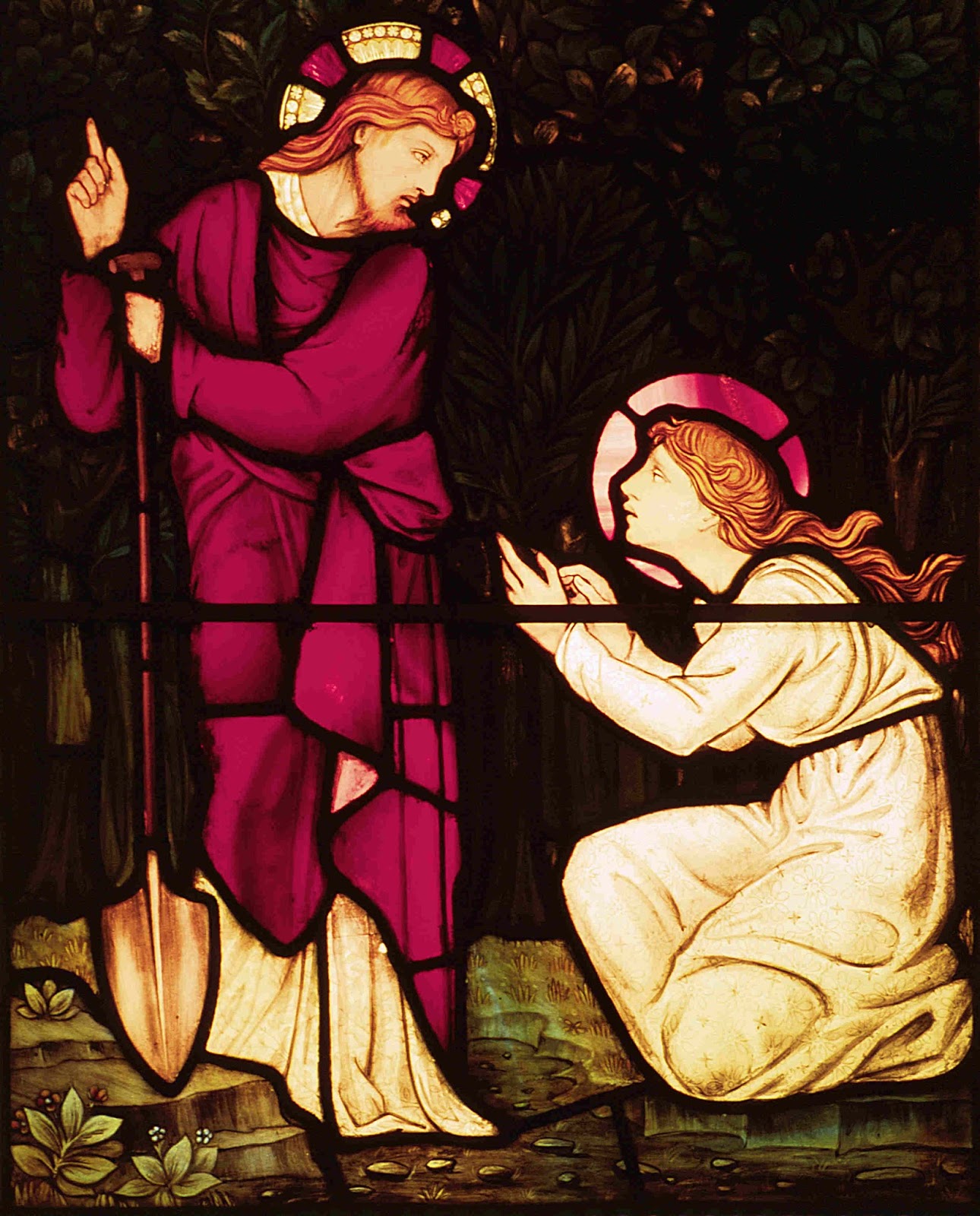
The Two Gardens


In chapter twenty of John’s gospel we learn that Mary Magdalene, having encountered two angels in the empty sepulchre where Jesus had lain, turns around and sees a figure whom she presumes to be the gardener. From these brief details of scripture we can picture the entire setting: We are told that Mary does not actually enter the sepulchre but merely looks through the entranceway from which the great stone has now been rolled aside. And we also are told that the figure is a gardener: the sepulchre must be set in its own garden, which is what we would expect of a tomb owned by someone as wealthy as Joseph of Arimathea.

The ‘gardener’, as Mary realizes, is the risen Jesus. “Touch me not” Jesus cautions her, for he is in a state between realms, halfway between the physical world and the realm of the spirit. These few brief verses give us no indication as to Mary’s emotions. We are merely told in that moment of recognition that she addresses Jesus as ‘Rabboni’ or Master. But we readily can imagine how Mary must have been overwhelmed with astonished joy!

So here is Mary, poised at the entrance of the tomb, poised between the world of material life and the world of the spirit, and here is Jesus, also poised between those two same realms. They are both in a state of awakening. Through her life’s contact with her spiritual master, this is Mary’s moment: the essential transition between the teachings of the way of the spirit and the actuality of the spirit’s presence and the conquest of death itself. And this also is Jesus’ moment: his farewell appearance both to Mary and a little later to his disciples in his material form before he becomes Spirit forever.

But why would Jesus choose the form of a gardener? Great happenings tend to move in great cycles, and this is visualised by the image of the Ouroboros – the serpent holding its own tail in its mouth. So let us follow that image back to another serpent – or perhaps it is merely the same serpent in another guise.

We are in Eden. Adam the gardener tends his garden: we even refer to this place as the Garden of Eden. And at the centre of this garden is the Tree of the knowledge of Good and Evil, which we know is really the tree of mortality, of the death of the physical body, should its fruit be eaten. Adam and Eve inevitably eat of the fruit and so lose their immortality, and must incarnate into the material world, with death waiting at the end in the hard world beyond the garden’s walls. But the second gardener in the book of John is the mirror of these events in the book of Genesis. Adam the gardener of Eden was in transition from the spiritual to the physical. Jesus the ‘Gardener’ is in transition from the physical to the spiritual.

What now lies before Mary is a task in the world, of living out the ultimate lesson of the spirit which she now has witnessed and learned in that far-off garden by the sepulchre. Her master awaits an even more profound awakening in the realm of the spirit, but for Mary it is the message of the joy of life that conquers death which lies on her lips now.


Stained Glass of Jesus and the Magdalene designed by Edward Burne-Jones

Sunday, February 11, 2018

Letting Go - An Act of Love

The phrase ‘letting go’ perhaps tends to be used rather casually. But there surely is a difference between letting go an unkind remark someone might have said to us, between urging ourselves to ‘let it go’, and the letting go of something so deep that it feels like death. This type of letting go is never easy and requires enormous courage. This type of letting go takes us on a journey that is highly personal, and only the person involved can do this in her or his own time. It is a lone process: no one can do it for us.
It is the act of letting go of a loved one. 
As Rainer Maria Rilke wrote in one of his poems: "We need, in love, to practice only this: letting each other go." Letting go of a loved one is a recognition that we never really owned anyone or anything. It is a conscious act of great love and faith. For no one wants to part from a beloved one. 

The act of letting go itself seems to be an ongoing state of being; like the tides, one's emotions tend to ebb and flow, and these processes never seem to go quite in a straight line. But slowly, slowly, a little drop becomes the ocean and things find the level which is intended for them.

Often we have dreams of what we want in life, including who we want to be with, and how we want things to be. But sometimes life itself says 'no': we realize with terrible finality that our dreams are not to be, and our most sought-after aspirations are doomed to remain unrealized. Then what?
The author Clarissa Pinkola Estes describes such a situation as: "leaving what cannot be." But what is this "leaving?" How do we stop reading the same chapter again and again? How do we stop the same looped recording playing over and over in our thoughts?

This more profound act of letting go is a deep acceptance, a surrender to what is, a realization of how things truly are, and a leaving behind of any desire for how we would like or prefer things to be. Saying ‘yes’ to this type of letting go irrevocably changes and transforms us. It is not a matter of hardening our hearts, of closing them so that no pain can enter. For if we close our hearts in this way, and with this intent, then not only do we not let pain in: we allow pain that is there to become trapped and to find no escape. The pain stays within us.
Instead, if only we open our hearts completely, if we open our hearts as wide as the summer skies, then not only all our joys and loves are embraced, but also all our pain and suffering and emotional turmoil. This is the marvelous paradox: in embracing our pain we also truly ‘let it go’. Inner freedom comes from this.

And so letting go is a deep acceptance, a surrender to what is. Every living soul on this earth, whether in physical or in spiritual despair or distress, is walking this road at some stage in her or his life. And it is up to each and every one of us to break through that hidden isolation and take that one step nearer to the real freedom which comes with truly ‘letting go’


Painting by Isil Gönen