Thursday, November 14, 2013

Birds of Passage


A wise rabbi once said: “It is a great challenge always to be in joy, to make yourself strong, and with all your force, to banish sadness and bitterness out of you. All sickness that comes over human beings, come forth out of the descent of joy. The descent of joy comes from the deformation of the ‘deep song’, of the vital rhythms. When joy and this deep song are affected, sickness can overcome us. Joy is a great remedy. It is important to find one place in us which gives us joy, and attach ourselves to it."

Another wise voice – that of Khalil Gibran’s – said of joy and sorrow: "Your joy is your sorrow unmasked, and the deeper that sorrow carves into your being, the more joy you can contain." 

Joy works in us. To enjoy – to ‘en-joy’ – is a way of living which gives spirit and flow. Joy seems to embrace a whole spectrum of verbs: to trust, to heal, to give, to receive, to dance, to sing, to share, to make love: all ways of living from the heart.

And we wish this joy for everyone, which is what can keep us going. But we also will encounter the pain of joy – the joy which has its borders:  borders which always will be there in some form. And when we experience injustice, it is this sense of injustice which can harden these borders. Still we know: I am on my life's journey. Like the migrating birds of passage, after their African sojourn, journey north  to breed and face storm and rain on their journey, in the same way the soul, full of joyful anticipation, hurries straight through the opposing forces towards her destination, which is complete joy.

The way of joy is a way to self-knowledge. For along this road of joy, just as the birds meet their headwinds and storms, we will meet our inner obstructions. We will be given a panoramic view of our fears and flaws, our weaknesses and pains, and we learn that we carry traumas within which cannot be healed. It is understandable that many of us will lose heart altogether, falling into grief and depression, or even face illness which no doctor can heal.

And still we make the attempt to keep enjoying, even though the social pressures to remain positive, to ‘look on the bright side’, can at times appear clichéd and hollow to the point of seeming cynical. For sometimes the pain is too deep, too fierce, for us to be able to discover the tiniest bud of joy in ourselves. But…

No night so dark that it will become morning again, is a line in a song by a Dutch troubadour.

We have to break in order for the light to come in, a dear friend once said to me. How right he was. For in the crack of breaking one will see, however small or faint, this spark. It is the spark of creation! However softly-glowing, it will find its way to our wounded heart, and begin to shine from within. The more we hold on to it, nurture it, the more this creative joy comes to light, and back into our life again.

When that wise rabbi asks of us to be strong, and with all our force to banish sadness and bitterness from us, and Khalil Gibran tells us that joy and sorrow are inseparable, I like to believe that they both contain their own truth. We all have experiences of joy and sorrow to know that we need to be strong like the birds of passage, facing storms and losses, but also experiencing those moments of pure joy, of effortless soaring over the moonlit oceans.


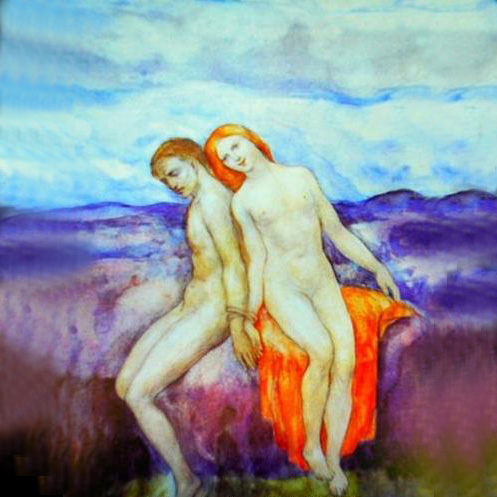
Painting Joy and Sorrow by Kahlil Gibran

Friday, November 8, 2013

On the Shores of Endless Worlds

The Bengali poet Rabindranath Tagore was a true mystic – but a mystic in the most human sense in that he allows us to see his fallibility, his constant wrestling with and searching for the form of his relationship with the divine. In this he is like another profound thinker, the Spaniard Miguel de Unamuno, who remarked that: "Faith which does not doubt is dead faith." 

Tagore's collection of blank verse poems known as 'Gitanjali' ('Song Offerings') we came across in an old Dutch edition from 1920. The Dutch is rather old-fashioned, and so we set out yesterday evening to write our own free translation into English. The poem draws no conclusion (and is the stronger for that), but listen to its sound: you can almost hear the rush of the waves onto the shore and the laughter of children. And the interweaving of innocence and experience, death and life, are played off against each other to the backdrop of Tagore's vivid and powerful setting. These things, Tagore seems to be saying, are not contrasts, but simply changing aspects of what is really a seamless whole.


***

On the shores of endless worlds the children gather. The infinite heavens are motionless above, and the restless waters are boisterous. On the shores of endless worlds the children gather, dancing, shouting, laughing with joy.

They build their houses of sand and play with empty shells. They weave their boats from dry leaves and laughingly launch them upon the unfathomable deeps. The children play their games on the shores of worlds.

They are unable to swim. They have not learnt how to cast nets. Pearl fishers dive for pearls, traders sail in their ships, while the children collect pebbles, only to discard them again. They do not search for buried treasure, they cannot cast fishing nets.

The sea rears up laughing, and pale glints the smile of the shore. Death-dealing waves sing songs without meaning to the children, as a mother who rocks the cradle of her infant. The sea plays with the children, and pale glints the smile of the shore.

On the shores of endless worlds the children gather. Storms course through the uncharted firmament, ships founder in the trackless watery wastes, death is abroad, and children play. On the seacoast of endless worlds is the great gathering of children.

From ‘Gitanjali’, by Rabindranath Tagore
Translated from the original Bengali into Dutch by Frederik van Eeden, and from Dutch into English by 


Thursday, October 31, 2013

Kindness


Kindness

Before you know what kindness really is
you must lose things,
feel the future dissolve in a moment
like salt in a weakened broth.
What you held in your hand,
what you counted and carefully saved,
all this must go so you know
how desolate the landscape can be
between the regions of kindness.
How you ride and ride
thinking the bus will never stop,
the passengers eating maize and chicken
will stare out the window forever.

Before you learn the tender gravity of kindness,
you must travel where the Indian in a white poncho
lies dead by the side of the road.
You must see how this could be you,
how he too was someone
who journeyed through the night with plans
and the simple breath that kept him alive.

Before you know kindness as the deepest thing inside,
you must know sorrow as the other deepest thing.
You must wake up with sorrow.
You must speak to it till your voice
catches the thread of all sorrows
and you see the size of the cloth.

Then it is only kindness that makes sense anymore,
only kindness that ties your shoes
and sends you out into the day to mail letters 
and purchase bread,
only kindness that raises its head
from the crowd of the world to say:
"It is I you have been looking for"
and then goes with you everywhere
like a shadow or a friend.

*
Naomi Shihab Nye


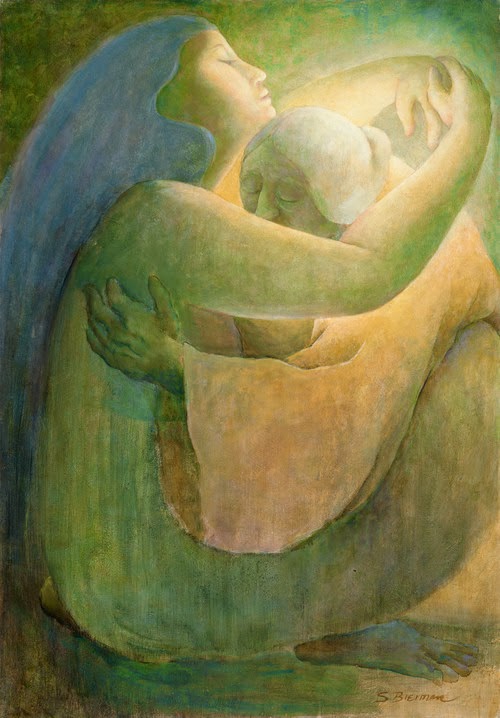
Painting Circle of Light by Sandra Bierman


Friday, October 25, 2013

Six Persimmons


How simple can a painting be? As simple, apparently, as the painting above, which depicts six persimmons (almost) in a row. It is painted on plain paper in black ink, so there is not even any suggestion of colour to stir our senses. It was painted in the 13th-century by the Chinese artist monk Mu Qi, and I have lived with this painting since discovering it in a little book of Chinese art which I bought for myself when I was still at art school – more years ago now than I care to remember!

But if this painting is so simple, why, then, is it widely regarded as one of the greatest works of art ever created? One can point out the virtuosity of the bravura brushwork, in which no single stroke is repeated, and the way in which even the little stalks on the fruit resemble Chinese calligraphy at its shining best. The composition as well is masterful, daring as it does to leave the top half of the painting completely untouched, and offsetting one of the six fruits below the line to add an unexpected dynamism. But all these things have to do with the technique behind the painting. They do not tell us why the painting endures after so many centuries, and what lessons it might contain.

Emma has given her blog the title of Sophia’s Mirror, and her introductory post tells us that Sophia, the embodiment of wisdom, is the creative force behind all things. But Sophia did not exist, as it were, of herself; she was not an equivalent of the omnipotent male creator god of scripture. Behind Sophia was the Unknowable – what Emma in a previous post described as the Dazzling Darkness – and Sophia was herself the first emanation from this Unknowable Mystery. This Mystery is conscious, and consciousness is thought. These thoughts remain as thoughts only. But Sophia with her creative powers can take these thoughts from the Mystery and give them form, make them actual. Whole worlds are created, with their tigers and their tamarind trees, their islands and their oceans and their wheeling flocks of seabirds. Sophia’s mirror reflects all that Sophia has created, all that she has made real from the emerging thoughts of the Mystery.

Look again at those six persimmons. Now view them, not as a whole composition, but as if they were a line of text. Whether you choose to read them from right to left or from left to right does not greatly matter: the result is the same. Those six simple pieces of fruit portray nothing less than the actual act of creation. At the beginning we are in a formless state: a blank emptiness, a ‘no-mind’ bounded by a grey but defining circle. It is the symbol of Zen. Moving along the ‘line of text’ this formless state is no longer a blank void. It is now filled with a tangible ‘something’. But Mu Qi’s brush is not yet fully-charged with ink: these ‘half-manifested’ persimmons are still an intermediate grey. Ah, but the centre persimmon! This one is solid black, as full of ink as the artist’s brush must have been when he painted it. This persimmon is fully-realised, a small piece of fruit manifested in reality. It is not a part of the shadow world to either side of it. It simply ‘is’.

And then the process goes into reverse: from black to grey and again to a blank nothing. Mu Qi (and Sophia!) have taken a raw unformed thought and made it manifest, have caused it to exist. But like life itself this existence is not the end. We have come from the formless, and to the formless state we shall return. How long did this painting take to execute? Sixty seconds? Less? Under the brush of a genius, six persimmons are still enough to portray the entire process of creation, and to chart, as on a graph, the course of every human life. 


Painting: Six Persimmons, by Mu Qi (Mu Ch’i), known in China as Fa-Chang. Ink on paper, Song Dynasty, 13th-century.
       

Saturday, October 19, 2013

Singing Very Softly


The conditions of a solitary bird are five:
The first, that it flies to the highest point;
The second, that it does not suffer for company, not even of its own kind;
The third, that it aims its beak to the skies;
The fourth, that it does not have a definite colour;
The fifth, that it sings very softly.

These beautiful lines by the 16th-century Spanish mystic John of the Cross are from verse 121 of his cycle of reflections Sayings of Light and Love. John himself tells us that the lines are intended to convey devotion to God, a surrender to the Oneness beyond our own limited horizons, and a sweet contemplation of the reuniting of the soul with the spirit. In this the lines convey the same sense of mystic surrender as Hildegard von Bingen’s comment that she saw herself as ‘a feather on the breath of God’. 

But lines which contain such greatness of spirit can reach beyond even the meanings which their author intended. The fourth condition, that the solitary bird ‘does not have a definite colour’, might at first puzzle us. Why should the bird have no definite colour? Everything in nature has a colour which can be defined. Outside my window I can now see the leaves on the trees turning from summer green to autumn gold. The colours of the leaves change with the seasons, but I still can look at them and see what colour they are. We habitually name things, we classify things into categories and subcategories. A lion is a lion, but it also is a member of the big cat family, which are in turn carnivorous mammals. Everything needs to be named and grouped. The book of Genesis even tells us that Adam’s first task was to assign names to everything in Eden.

Even when I watch a wildlife documentary, the narrator assigns names to those lions, apparently to make the animals more like human characters, and therefore to appeal more to the viewer. They become Sita the lioness and her cubs Manu and Pola: names which the animals themselves remain entirely unaware of. An animal identifies another individual by a whole package of sensations: sight, scent, touch, all working together. Maybe we should, instead of foisting names on everything, try to see the ‘whole package’ more. A name can become a label, and a label is used to define something.

As John of the Cross was aware, to define something can also be a way of limiting it, of imposing personally-perceived borders and restrictions, of confining that thing to a particular set of expectations that we might have about it. He had no wish to subject his solitary bird to such confinement. His precious bird of the spirit needed complete freedom to exist. Names and definitions can so easily become walls, and even to assign his bird a specific colour would have been to build a wall of sorts around it.

And John of the Cross knew about walls. Imprisoned by his own Carmelite superiors for his reformist views, he was confined for years in a dark cell barely wider than he was tall. The lines which begin my post were written on paper smuggled to him by his guard, and written by the dim light of a small window to the adjoining cell. His triumph was to dissolve the walls which confined him, to allow his solitary bird to soar to the skies, without restrictions, without definitions, singing very softly, but still with a song that would be heard over six centuries after he had launched it into the skies.   


Image: Performance of the Momix Dance Theatre Company 
photographer: Allessandro Bianchi

Friday, October 11, 2013

Sophia's Mirror

The planet we call home is a mirror. This is literally true, as the waters which cover so much of our world reflect the sky above them. The sea appears soft and grey or azure blue, depending on where we are and what the weather is doing. The waves reflect the sky. Last Sunday I stood on the shore and took the photo of the sea that is the background of my new blog header. The sea was glass-calm, and the weather was very still, and a little misty. Such absolute tranquillity invites reflection: a moving beyond the horizon-spanning surface which lies before us as we stand on the shore. 

For me, to stand on that particular shore was something of a personal fulfilment: a promise kept to myself to greet the sea once more after many years of personal trials. I stood there in silence, feeling the crunch of wet sand underfoot, breathing in the salt air on that perfect October afternoon, listening to the soft wash and sigh of the incoming waves – the tallest barely more than ankle-high. The simplest experiences can offer consolation, even a sense of redemption, of being given a new reason to have inner faith when faith has been something that we hardly dare to feel any more.

Having such inner faith can give a sense of peace, a deep sense that things are unfolding as they should, that all is as it is because that is the way it needs to be. Even just a simple trust in what might be round the corner for us can be a silent wish. But even this silence can be full of fierce longing. We plant its flag on some shore known or unknown, and the mere presence of that flag proclaims: ‘I am here – this is where I choose to stand’. And where we stand is a place which mirrors our deeply-felt inner trust, and all is reflected in its depths. But when we gaze into this mirror of trust, is it always our own face that we see? 

The Ancient World called her Sophia – Wisdom. She is the creative force behind all things, and a line from a text written in her name promises that she will come to those who reflect on her. That line was written over a thousand years ago, and the fragile text which contains it, known as Thunder, Perfect Mind, was lost for sixteen long centuries, buried in a jar in the Egyptian sands before being unearthed by chance. It is as if some things are just not meant to be lost. That text, which contains some of the most fiercely beautiful lines I know, was adrift on another ocean – the ocean of time – before at last being washed up on our own shore.

Written by an unknown hand, the clear voice of Sophia in that text reaches out to us once more across the centuries. Such endurance against all the odds provides its own powerful message of faith, for faith as well is not meant to be lost, however long it might remain buried. Now once more we can gaze into Sophia’s mirror and, if we choose to and if we are open to her spirit, it is her face that we will see there as well as our own.       


Sunday, September 29, 2013

The Songbird


Listen… listen. Head tilted, eyes half closed, the man listened. The thrush sang so enchantingly today. If luck was with him, he knew that he would not have to wait long for the answer from the other side of the bushes. Yes! Listen... there was the female… ah, she did not disappoint him. Oh, just listen… a little concert, all for free.

“Would you like to have French beans for dinner?” His wife’s voice beside him cut through the duet of nature. Everyday concerns returned with a little jolt, and the birdsong receded into the woodland background.  The man turned towards his wife with a disturbed glance. What in heaven's name was she talking about?
"What did you say?" he asked rather brusquely.
"If you would care for French beans tonight, maybe with a braising steak?"
"Woman! What has gotten into you? How can you think of braising steak right now?"
"With French beans." his wife added kindly, apparently unaware of having done anything wrong. "You do like that, don't you?"

The man looked at his wife as if at a stranger. Was it really possible to live on a totally different wavelength after so many years together? The thrush was now singing its heart out, right above them. Could it really be so that she did not even notice? He was astonished. His wife's reaction was beyond his comprehension.
"Why are you looking like that? Did you lose your tongue?" She nudged him, uncomprehending. "Or do you prefer French toast with rhubarb? It's at its best at the moment!"

Oh dear lord, she really did not hear the bird. The man inhaled with a slow whistling sound, pulled himself together, then patiently answered: "No, French beans is fine, you already have them in the house, after all." He thanked the thrush in spirit for its beautiful song. "Come dear, let us walk further," he said, and took her hand with a gentle gesture.

That evening at the dinner table his wife was very quiet, toying with her food. A little concerned, he asked: "Anna, is something wrong?"

"Anna?" 

She seemed to come from far away, answering him with a distant look: "How enchanting that was this morning. Did you hear it too? First the male, and then the answer of his lady friend... two voices, one song!" 
She paused a little, pondering, as if nodding in agreement over something.
But it was her husband who bowed his head in silence at her words:  "As long as I keep a greening twig in my heart, the songbird will always come."


To the memory of my mother who always kept a greening twig in her heart.


Tuesday, September 24, 2013

Spirit of the Forest


There is nothing here,
nothing.
Light and shadows of leaves,
and stillness.
Even the birds are silent now,
as if waiting 
for something to pass.
There is nothing here,
nothing.

You who walk here,
this is what you tell yourself,
what you would have yourself believe.
Why, then, does your step quicken
towards the light at the forest’s edge?
Why, then, do you no longer 
glance behind 
as you tread the carpet of leaves?

Have you so distanced yourself
from my world
that my body has become a thing
of revulsion to you,
something that you would prefer 
not to see?
How, then, do you imagine me?
Brown mould-face, 
tangled twig-hair,
cracked bark-flesh?

Look!
Look now, right behind you,
if you dare.
For only by daring to look,
will you see how beautiful I am.

Look, look now!

Perhaps there is nothing here,
nothing.
Just light,
and shadows of leaves,
and stillness.


Dryad  by  Victoria Pettella

Monday, September 16, 2013

September's Morning Mists


The morning mists blanket the farmlands in silence. In the distance a cow is lowing. Closer-by a horse whinnies. The goats in the field next to the last farm walk stiff-legged and sleepily about, in search of forage. They look up momentarily as the early wanderer passes them, then continue further undisturbed. His footsteps echo muffled on the cobbles. The sprightly tapping of his walking stick strikes the beat. Step tap step, step tap step, in flowing cadence.

The road in front of him lies as yet undiscovered; the village behind him still lies deeply at rest. This is the most beautiful hour of the day, when the damp night air with its purple-grey tints slowly makes way for the diffuse gold of the rising sun. When the spider webs heavy with dew hang glistening in the light of the new morning, and the majestic poplars along the road stand tall and silent above their own watery reflections.

The wanderer stands still and looks up to the crowns of the trees moving in the breeze, and he wonders aloud: 'How many others have you seen go by in their haste to be elsewhere, without once standing still.. without once even looking at you?' Again a cow lows - now closer-by, as if she urges the wanderer to go further. He nods thoughtfully to the poplars and walks on. The mist begins to evaporate in trailers, the light changes colour.  Slowly the deep black water is restored to its daylight blue. The ducks, still at rest, their heads tucked well away under their wings, are not aware of the wanderer. They lie in the wet grass. Not one is moving. When he returns along this road, he knows that they will be busy foraging. He grins aimiably.

A motor boat approaches. The muffled gurgle of the motor penetrates the stillness. The once-smooth water surface begins to ripple and wrinkle like the face of an old woman. Still there is nothing to see, but it doesn't take long before a figure looms out of the mist. With his cap pulled well-down above his eyes he calmly steers his boat, knowing that in spite of the mist his course is straight ahead. The skipper touches his cap with a finger by way of greeting. The wanderer lifts his walking stick in silent acknowledgement.

The boat leaves a ripple behind it on the water, and the crowns of the trees move with their reflections. He looks up again, the trees stand as directionless as before. But the man knows, while he stares at the water's surface, that they too were touched by the silent presence of the passing boat. 'That's the way it is.' he mutters. 'Each change finds it echo. Even the smallest movement makes a difference.'.

He walks on as he loosens the top button of his coat. It begins to feel a little warmer. The first rays of the sun take hesitating possession of the chill night that has stirred him so early. The light changes quickly now. Rays of sunlight fall across the revealed landscape, and the man sees a wider view of the world. The cows are no longer hidden in mists, the reeds comb the roots of the poplars that sigh in the soft breeze of morning. They also greet the sun in their own way. The man breathes in deeply, and throws his coat open, he stretches his arms and allows his walking stick to point upwards, towards the sun, towards the sky, towards the tops of the trees. He turns around in a circle and touches everything, to the farthest point.

The animals look at him, the cows chew the cud slowly, a horse whinnies and begins to trot. The ducks are awake and spatter around. Nature awakens, and each creature in the peaceful world is in its element.

The rest of the world is now also awake. A farmer drives past him on a tractor. The man wanders further, the sounds of the new day dominate his passing, and the magic is silently withdrawing in invisible haze.        


Monday, September 9, 2013

Tides

Like the tide of the ocean
my body just holds its balance
between sea and sky
between worlds
the drum of the wave
almost claims me
but I hold my ground.

Love is like the ocean tide 
that tugs and pulls 
then withdraws herself once more
returns to devour the land
leaving behind what no longer interests her
later, like a proud woman,
she slides back once more
in her fluidity.

How dear this ocean is to me
how I yearn for her fierce power 
when I cannot be with her
when she is far from me
Sea, sky, land
and the roar of the breakers
defining her territory with their song
There you can find me
ever again.

It is the motion
which draws me back
each time again
only to leave once more
just like the waves
just like the tides - 
these are the forces which sustain me

My stories are written
in the rise and fall of the waves
which carry the invisible imprint
of my existence
to the far and undiscovered shores
of Love.


Sunday, September 1, 2013

The Way to Heaven


We know by his sword and a glimpse of grey steel armour that this is a knight who is being borne heavenward. His dark shroud billows around his bier, which is carried by four of the heavenly host. All around are soft cumulus lit by the rosy light of an evening sun, and the whole mood of the painting suggests that this is a noble hero going to his rest.

How did this knight die? We cannot know, although we might presume that death came in battle, or as the unexpected climax of some adventure or undertaking. Our imagination might reach to the idea of a betrayal, or even an unexpected but peaceful death whose cause lay far from the field of battle. But the knight died, and his deeds in life have assured him a place among fallen heroes. 

But who are these heroes? In George Eliot’s novel Middlemarch, the events in the village of the novel’s title weave and swirl around a character whose deeds of common humanity go largely unnoticed by her fellow villagers, but whose mere presence among them constitutes a state of grace. Her simple existence represents something ineffable, something beyond the worldly, as she moves through the distractions of the everyday chatter and gossip around her. Our own humanity recognises this character as a good person. The author gives her readers the space to draw their own conclusion about this character: that in her own way this pure soul is also a heroine, although her own deeds are far distant from, and more subtle than, the more obvious heroic gestures of our knight.

What we respond to, what we recognise, is a sense of ‘doing the right thing’. Many who do good work, or perform some selfless act to help others, are noticed and acknowledged for their actions by those others. Perhaps such recognition might even happen through mere chance: that their actions were witnessed by the media, or for some other reason of circumstances. But we also realise that for every individual who might receive recognition – perhaps even a civic award – there are many more who remain unsung, never receiving acknowledgment for their selfless humanity.

We might wish to think that their reward lies along the way to heaven. But this is a matter of belief, not certainty, and death remains an unknown, even for those who might believe passionately in an afterlife. It is here while we live that we must seek to find that state of grace, whatever our personal beliefs or non-beliefs might be. To move through the world in grace, neither looking to right nor left, with all their distractions along the way, is the way to heaven, whether such a way ultimately exists or not.


Painting: Avatar, by Henry John Lintott, 1916.