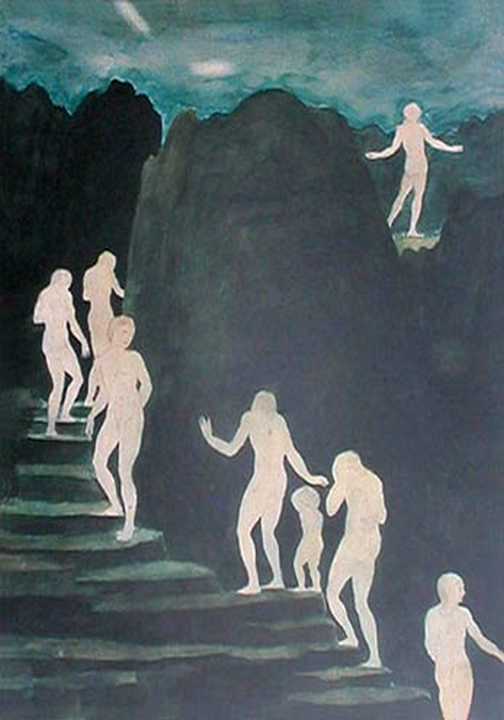
Sunday, March 24, 2013

The Carpenters


The Carpenters

Ours is a work of wood.
It’s what we do, you see:
shaping, planing,
one piece to the other,
length by length
and beam by heavy beam,
cut from the cedar tree.
Adze, plane, auger and saw
chest for a dowry, lintel for a door.

There’s two of us
here in this workshop
scuffing through shavings,
with orders stacking up
and another just come round:
three more beams needed -
only the cross-beams, of course.
The long uprights
wedged, thrust deep into the ground
stand waiting up there on the hill
and we wonder:
this time, who’ll ride the thunder?

Maybe three rebels,
their shouts of sedition unheeded
or they could be three robbers,
bound for heaven or hell - 
or neither of these, who’s to tell?
As if confirmation was needed.

They say some prophet on a donkey
who was greeted like a king
rode by a week ago or more.
But prophet or king,
he’ll wear our wood on his back
and that’s for sure -
bent with the weight of earthly folly
and there’s no lack
of that  - not yesterday
or any time before.

So we’ll shape this tree for a king
and we’ll shape it good
and he’ll carry it up that shadowed hill
and he’ll feel the rub of our wood
and he’ll know its tender mercies
and they’ll be both his and ours
but he’ll feel the weight of our wood no more
as it carries him to the stars. 


Painting: artist untraced

Tuesday, March 19, 2013

Rachel, a Woman Disciple


Rachel, a Woman Disciple
on Jesus, the Vision and the Man

I often wonder whether Jesus was a man of flesh and blood like ourselves, or a thought without a body, in the mind, or an idea that visits the vision of man.
Often it seems to me that he was but a dream dreamed by countless men and women at the same time in a sleep deeper than sleep and a dawn more serene than all dawns.

And it seems that in relating the dream, the one to the other, we began to deem it a reality that had indeed come to pass; and in giving it body of our fancy and a voice of our longing we made it a substance of our own substance.

But in truth he was not a dream. We knew him for three years and beheld him with open eyes in the high tide of noon. We touched his hands, and followed him from one place to another. We heard his discourses and witnessed his deeds. Think you that we were a thought seeking after more thought, or a dream in the region of dreams?

Great events always seem alien to our daily lives, though their nature may be rooted in our nature. But though they appear sudden in their coming and sudden in their passing, their true span is for years and for generations.

Jesus of Nazareth was himself the Great Event. That man whose father and mother and brothers we know, was himself a miracle wrought in Judea. Yea, all his own miracles, if placed at his feet, would not rise to the height of his ankles. And all the rivers of all the years shall not carry away our remembrance of him.

He was a mountain burning in the night, yet he was a soft glow beyond the hills. He was a tempest in the sky, yet he was a murmur in the mist of daybreak. He was a torrent pouring from the heights to the plains to destroy all things in his path. And he was like the laughter of children.

Every year I had waited for spring to visit this valley. I had waited for the lilies and the cyclamen, and then every year my soul had been saddened within me; for ever I longed to rejoice with the spring, yet I could not.

But when Jesus came to my seasons he was indeed a spring, and in him was the promise of all the years to come. He filled my heart with joy; and like the violets I grew, a shy thing, in the light of his coming. And now the changing seasons of worlds not yet ours shall not erase his loveliness from this, our world.

Nay, Jesus was not a phantom, nor a conception of the poets. He was man like yourself and myself. But only to sight and touch and hearing; in all other ways he was unlike us.

He was a man of joy; and it was upon the path of joy that he met the sorrows of all men. And it was from the high roofs of his sorrows that he beheld the joy of all men.

He saw visions that we did not see, and heard voices that we did not hear; and he spoke as if to invisible multitudes, and ofttimes he spoke through us to races yet unborn.

And Jesus was often alone. He was among us yet not one with us. He was upon earth, yet he was of the sky. And only in our aloneness may we visit the land of his aloneness.

He loved us with tender love. His heart was a winepress. You and I could approach with a cup and drink therefrom.

One thing I used to understand in Jesus: he would make merry with his listeners; he would tell jests and use plays upon words, and laugh with all the fullness of his heart, even when there were distances in his eyes and sadness in his voice. But I understand now.

I often think of the earth as a woman heavy with her first child. When Jesus was born, he was the first child. And when he died, he was the first man to die.

For did it not appear to you that the earth was stilled on that dark Friday, and the heavens were at war with the heavens? And felt you not when his face disappeared from our sight as if we were naught but memories in the mist?

Kahlil Gibran - from Jesus, the Son of Man, 1928

Drawing by Leonardo da Vinci


Tuesday, March 12, 2013

Angel


Angel

Oh, if only you knew how your face changes
when in the midst of our silent, pure uniting glance,
you lose yourself, turn inwards and move away from 
me !
Like a landscape, that just before was so clear
you become clouded, shutting me out.
Then I wait. I wait silently, often for a long time.
And were I someone such as you
then the pain of a love scorned would kill me.
But now…
now I have infinite patience from the Blessed.
So now, unperturbed, I wait for you,
whenever you might come.
And I take this soft reproach,
not as a reproach, but as absolution.

*

O wüßtest du, wie sehr dein Antlitz sich
Verändert, wenn du mitten in dem Blick,
Dem stillen reinen, der dich mir vereint,
Dich innerlich verlierst und von mir kehrst!
Wie eine Landschaft, die noch eben hell,
Bewölkt es sich und schließt mich von dir aus.
Dann warte ich. Dann warte schweigend ich
Oft lange. Und wär ich ein Mensch wie du,
Mich tötete verschmähter Liebe Pein.
So aber gab unendliche Geduld
Der Vater mir und unerschütterlich
Erwarte ich dich, wann du immer kommst.
Und diesen sanften Vorwurf selber nimm
Als Vorwurf nicht, als keusche Botschaft nur.

Christian Morgenstern

(1871 - 1914)


Painting: Odilon Redon

Sunday, March 10, 2013

What Women Truly Wish For


In the place where legend and history intertwine with each other, and the deeds of heroes are more than stories, the bold knight Gawain rides out from the court of King Arthur. Our gallant hero has determined to find an answer to the question which once had been asked of his monarch, and to which the king himself had no answer. Namely: what is it that women truly wish for the most?

Through the deepest woods and wilds our knight rides, until one day in a shadowed glade he encounters a grotesque form standing bent but resolute in the middle of the way. Such a walking rag pile could only be a witch, and indeed so it proves, as the hideous hag looks up and meets the imperious gaze of the knight. He commands her to stand aside and let him pass. Well, of course he does. He is, after all, an important knight on an important quest, and has no time to waste on this hag who seems less of a woman than a demon. But the knight is riding through legend, where all reality is enhanced, and nothing is what it seems. 

In cracked tones the hag announces that she knows the answer to his unspoken question. That, naturally enough, gets our hero’s attention. He demands of her that she demonstrate to him that she indeed knows the question which is in his thoughts, otherwise how can he believe her?

‘I shall do more than that, Sir Knight,’ croaks the hag, ‘I can help you with the answer! But to hear my words, you will need first to dismount and grant me a sweet kiss..’. So driven by curiosity, or by loyalty to his liege, or by remembering that in the legend through which he is riding a kiss can have unexpected consequences, our hero dismounts and (presumably with his eyes closed during the moment) puckers up and meets those leathery lips with his own. Legend remains true to form, and on the instant of those oh-so dissimilar lips touching each other, the hag is transfigured into a beautiful maiden. 

‘And now that your valour has descried my true appearance,’ says the fair Ragnall (for that indeed is the lady’s name) ‘it only remains for you to ask for my hand in marriage, and then the answer which so eluded your king will be given to you. Namely: what is it that women truly wish for the most?’ 

So after some inner turmoil, or perhaps after wrestling with a very un-legendary fear of commitment, our brave knight duly and dutifully pops the question to the fair Ragnall. Ah, but then comes the following question…

‘So what will you now, my dear betrothed?’, asks the lady, ‘that by the day’s clear light I remain as beautiful as you see me now, and that in the grey night’s shadows I take my hag form? Or perhaps you would prefer things to be reversed, and you would have my hag by the harsh light of day, and know me only in the moon’s dim light as you now see me?’ Ah, poor Gawain… what to choose? Once more our hero is plunged into inner turmoil. And perhaps for that very reason he searches ever deeper into his own being for the answer. And the answer comes.

‘Dearest,’ Gawain at last proclaims, ‘you should decide for yourself what you wish, for surely your true form is whatever form you yourself choose to take.’ Ah, our hero has found the perfect answer at last! Marriage duly and dutifully follows… and with the riddle resolved legend prevails, and the shimmering beauty of the fair Ragnall shines forth both by day and by night. 

For what women truly wish for is in the end no different from what men also truly want, which is no less than to be wholly accepted for who they are – whatever that might be, and in whichever way our life’s circumstances might change us.


Painting: La Belle Dame sans Merci by Mark Fishman


Tuesday, March 5, 2013

The Turning Field of Stars


Deep in myself,
too deep for me to reach
is the earth
I am that earth.
The heavens wait for my arrival
I am those heavens
which stretch down to receive me.
I am a pilgrim
travelling this wheel of stars
seeking a new heaven
and a new earth
I am those stars
that watched and saw
how the old heaven and the old earth
had passed away.
And so among the turning field of stars
I tread the underworld above
to free myself from these cycles
of dialectic powers:
these eons with their traps,
temptations of thought 
before I'll find that light
which leads me through the refining fire
to my transfiguration
and the resurrecting of the inner God.


Painting by Briton Riviere


Wednesday, February 27, 2013

The Crossing


The Crossing

Look: that’s me on the right
with my daughter’s eldest daughter.
We sit on sacks of grain, she and I,
in the white Siberian light,
afloat between the brightness of the water
and the brightness of the wide and hollow sky.

Now we near the shore.
The dip and splash of oars
breaks the slow silence
of the river's run,
stirs spiralled mud in the shallows:
another crossing nearly done.

I have crossed over so many times.
My Oka. Not so great 
as the Ob or the Don, I know,
but still my river, borrowed from God,
born from distant Altai snow
through winter's ice and summer's heat.

‘Are you thirsty, Babushka?’ someone asks.
But I’m used to thirst.
I’m grateful for the thirst
That lets me know I’m still alive.

I’m grateful for the strong arms of the rowers
and for my granddaughter’s quiet company
beside me in the white and silent sun.
I’m grateful to the sown, and to the sowers,
I’m grateful for this harvest-seat of grain.

I’m grateful for my tired eyes,
For the tiredness of my body
that tells me I’ll be grateful for
another crossing soon to come
towards a yet-untrodden shore
beneath another brighter sun......


Painting: On the River Oka, by Abram Efimovich Arkhipov, 1890


Friday, February 22, 2013

"To Thine Own Self Be True"


When the world was much younger than it is now, and the gods were less shy about making themselves visible to us mortals, there was a king called Pygmalion. The king had fallen hopelessly (and inappropriately) in love with no less a being than Aphrodite, the goddess of love. However much he begged her, she refused (naturally enough) to sleep with him, until at last in utmost despair he fashioned an exquisite ivory likeness of her, placed it in his bed, and lay down beside it.
  
When Aphrodite saw him lying there lovelorn, with only the embrace of cold ivory for company, she at last took pity on the king. Her spirit then entered the sculpture, imbuing it with the seed of life which it is the grace of a goddess to give. With a king's kiss the transformation began, as beneath Pygmalion's wondering touch hard ivory became yielding female flesh. And this is how the carved likeness became transformed into a living woman, who in later retellings of the story acquired the name of Galatea.

Whether or not Pygmalion found happiness with his Galatea is for us to speculate upon. What we both recognize and respond to in the story is the way in which the king projected all his fantasies and his longings, not onto a real person, but instead onto a mere image which he himself had created. The heart of the story contains the powerful recognizable truth: that we often do not see another for who they truly are, but rather as we would wish them to be. And so it happens that, like Pygmalion, we create someone in our own image. 

This can have its appeals - but when it happens within a relationship, it also can have its dangers. A top sportsman might find it flattering to his ego to have a supermodel on his arm, but there still is a human being beneath those supermodel looks who might not be seen for who she truly is - either by him or by the hotly-pursuing paparazzi. But the story of Pygmalion's fixation with a created image can also apply to more spiritual 'sculptures' which we create - even unconsciously.

We all have our own ideas about 'God', both according to our beliefs (or lack of them) and to our personal views within those beliefs. But just how difficult it can be to let go of these thought forms is demonstrated by the mystic Meister Eckehart when he cried: 'Oh, God, help me to release myself from God!' He understood that unless he could let go of all the preconceived images of God which he held, and so make himself a receptive 'empty vessel', he would never be able to draw close to the true nature, the true being of God.

And it even can be the case that we create Pygmalion-style 'sculptures', not just of others, or of the forms in our beliefs, but of ourselves. This could happen because we wish to project a certain image of ourselves to others, or because we seek to please someone - perhaps a partner - by being who they wish us to be, rather than who we truly are. And so we turn ourselves into sculpted 'statues', for the sake of wishing to be more accepted and loved by another. For this reason I can't help wondering if Galatea was herself truly happy. After all, she was the living creation of the wish fulfilment fantasy of Pygmalion, and (assuming that the story has its own inner reality) must have wondered about her own true identity.

"To thine own self be true" advises Polonius in farewell to his departing son Laertes in Shakespeare's Hamlet. It is the best - and at times the hardest - advice to follow!


Drawing 'Pygmalion' by Edward Burne-Jones


Saturday, February 16, 2013

My Own Name


My Own Name

I wind myself in braided vines
winds from the sun, and starry fields       
and clothe myself with woven sounds
that a royal child shields.

I seek to pluck the ripest fruit
whose coursing sap runs through my veins
and through the canopy of leaves
I'll sing the colours of refrains. 

Towards the meadowlands I turn
where wild flowers and soaring lark
spread fragrant air and airy song
above the azure lake. 

And I will plant a future glade
in raw grey earth and stable ground
and count the numbered grains of sand
and smooth the stones to pebble-round. 

The streams and rivers I release
to flow towards the mountain crest
where sun and moon will stand as one
and the winged horse finds its rest. 

Then garlanded with mountain songs
of eagle's cry and feathers roan
I touch the sky and voice at last
the name which is my own.


painting: Birth of Venus by Odilon Redon

Tuesday, February 12, 2013

The Transforming Journey


The Journey of Inner Transformation from Suffering to Freedom

Suffering is a universal human condition. We do our very best to avoid it but very few of us can. Buddha talked at length about suffering. He called it "dukkha" which includes the entire spectrum from dissatisfaction and discomfort to intense pain and suffering. He discovered a way to end suffering and find lasting peace - a peace he calls Nirvana. Many sages and spiritual masters have touched upon this human condition. Although suffering is an unwelcome condition it can develop in us a greater depth of soul and gives us the capacity for deeper compassion. Suffering acts as a crucible in which we undergo inner transformation, a transformation that shatters the very core of who we think we are and opens the doors to deeper perception and realization of what may be called our true Self within.

We do not need to intentionally seek to suffer to experience transformation.  The way to transformation may be practiced without the presence of suffering. Suffering can lead to inner transformation. This transformation can happen right in the midst of suffering. Such an experience is often revelatory and some call such experiences "awakenings." These changes can lead to further awakenings and life itself becomes a journey of transformation. It is a spiritual journey, as each awakening shatters one's previous concept of self and allows discovery of deeper levels of being. It is a journey that leads us to that place within which reveals our true nature or true Self, that place in which we are at the matrix of creation, and the fountainhead of peace, love, joy and freedom, and these states are emanations of the true Self and not separate emotions. 

Suffering is invariably caused by the "desire gap." This is the gap between what we want (desire) and what is. What we want can be anything - an event, a person, a set of specific circumstances, material things, a physical condition, etc., but they are all personal mental and emotional projections. Of course, what "is" happens to be the undeniable "reality" in front of us that we find hard to accept. This is the seed of suffering - the gap that exists between what is and what we want. 

When one has reached a point of being utterly exhausted from suffering, and arrives at juncture where there appears to be no exit point, no escape route, and the mind offers no solution, it is in this state of existential crisis that a transformative opportunity arises. It does involve the act of stopping the mental and emotional bicycle that we have been on to look squarely into the face of suffering. 


For one moment we must stop, completely stop, and step back from the emotions and thoughts.  Stopping leads to recognition, to simply place full attention on one's feelings and thoughts. Recognition is awareness, and awareness requires stopping even for a brief moment. One's suffering must be confronted squarely. Rather than turning away from it, look into its face with courage by quietly placing attention on it. In order to transcend it one must accept it and embrace it.

Our suffering may consist not only of the pain itself but also the desire for the suffering to cease. We may be overwhelmed by both pain and desire.  It may feel impossible to stop. We feel overwhelmed because we are identifying intimately with our thoughts and emotions. However, know that we are deeper than any thought we could think of.  We are deeper than any emotion we may feel, whether that emotion is sublime or ugly. Stopping does not mean rejection or repression of our thoughts and emotions. Rather it means letting them be and observing them as a witness. Awareness requires us to focus our full attention on what is happening inside us. By doing so we open a small gateway to our heart of hearts, and there is the softest whisper that may be heard inviting us to enter.

The road of suffering divides into two paths, and both paths lead to transformation. It is up to the individual which path to take. It is a personal choice. The first path is that of acceptance. The second path is that of release. Both involve an element of surrender in slightly different ways. However, the end is the same.

The path of acceptance requires resolve. The emotions of suffering are wholly accepted and embraced. Accept and embrace the suffering - even if the condition of suffering is for the rest of one's life - say yes to it. As Christ accepted his crucifixion and his cross, embrace one's own cross in an act of surrender. From this surrender the suffering will be transmuted to liberation. The path of release requires courage. In the path of releasing, one needs to release the desire in the "desire gap." It may also be described as surrendering, surrendering in the sense of letting go, of the one prime desire inherent in the "desire gap."

In the path of release, by giving up what you desire most of all there is not only a shift of one's sense of self, but a major falling away of one's identity. This crumbling of identity also occurs with the path of acceptance. If you accept what you once deemed unacceptable then this impacts upon one's sense of self. However, this is not to be feared. In the falling  away of one's perceived identity is the realization that the identity was not real to begin with. It was self-created over time, supported by family, friends, peers and society in general. The imaginary construct of self was held in place by a myriad opinions, judgments, and thoughts - all of them insubstantial. This false identity is sometimes called the ego or the small self. Upon this realization we suddenly experience an overwhelming sense of freedom and joy. We have peeled away layers of illusion to recognize something in us that is more real. This is an awakening to one's true nature or one's true Self. It may be a small and gentle glimpse or an overwhelming experience - again it does not matter. It is the end of your world as you know it and it is the beginning of your journey, the journey of transformation.


"There is a place within, even in deep sadness, where you are totally whole and complete." 
~ Rumi


paintings by Kahlil Gibran

My special thanks to Joseph for writing this post at my request.


Tuesday, February 5, 2013

The Longing


The Longing

I am dreaming
I am dreaming everything –
and everything which happens to me
happens because I dream it.
My dreams are not always the dreams
which I wish to have – 
but they are the dreams
which I choose to have.
They are my dreams,
both good and bad –
for that is my choice
and to imagine that there is no choice
is also a choice.
There is always a choice –
always.

I am longing
I am longing for everything –
although I do not always know
what it is that I long for.
Neither do I need to know – 
for not knowing is for me
the most precious longing of all.
This is the longing of my heart’s secrets
and my heart does not tell me everything – 
neither would I wish it to
for I will know all these things one day
when I awaken.


Pastel  Portrait of Emma © by David Bergen


Friday, February 1, 2013

Sacagawea


To know the ways:
The wide rivers’ courses,
the secret trails
untrodden by the steps
of those who walk without seeking,
the unseen traceries
left by the flights of birds
like lace across the sky:
For this she journeys 
with the makers of maps
and of history,
plotting her own charts
invisible to others:
She crosses inner meridians,
strange horizons,
new wildernesses of the heart.